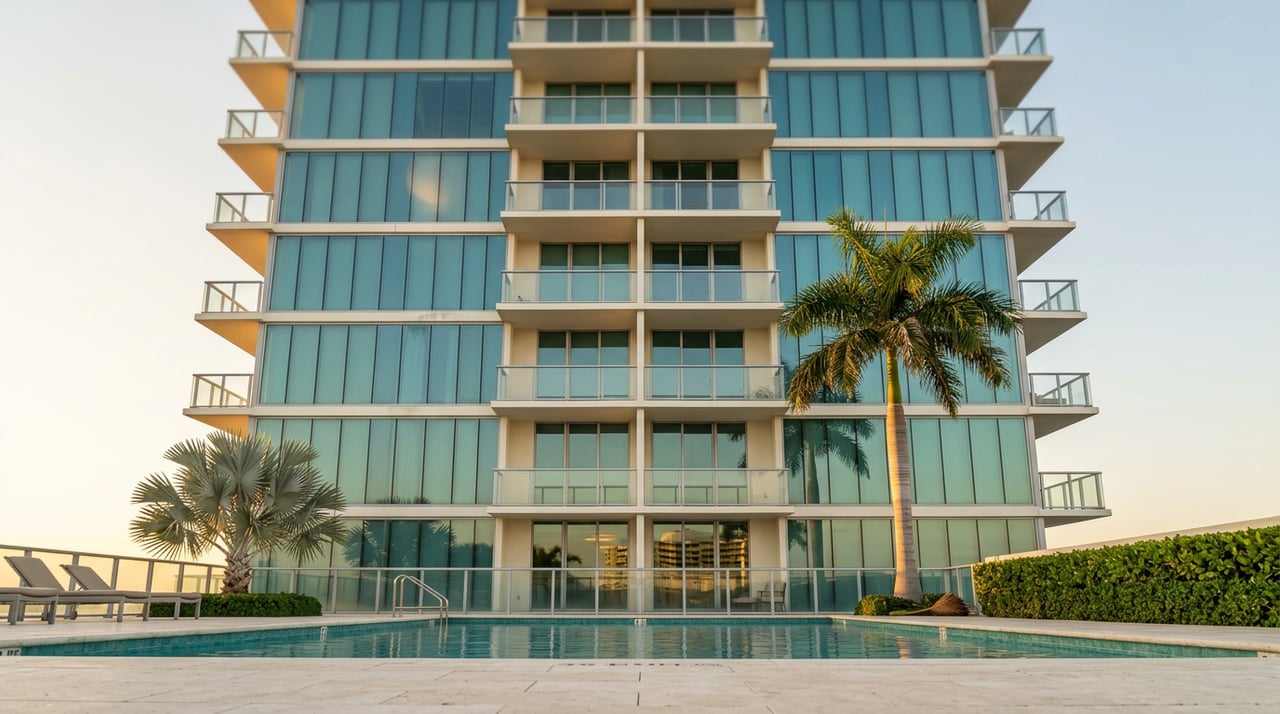
In late 2024, owners at 1060 Brickell opened their mail to find a bill nobody had budgeted for. Just 16 years after construction, residents of the two towers faced a contentious $21 million special assessment, with some unit owners on the hook for payments exceeding $40,000. One resident put it bluntly to CBS News Miami: "I feel like I'm being milked."
That building is still working through the fallout. Building records show 1060 Brickell has gone through a $21 million special assessment averaging over $35,000 a unit, a contested board election, a state-certified recall, and a court-ordered board replacement. The two-tower, 45-story complex of 592 units was completed in 2008, which puts its first legally mandated milestone inspection in the early 2030s, roughly seven years from now. The board chose to fund and execute the structural work years ahead of that deadline instead of waiting for an inspection to force the issue.
That timing gap is the story most Brickell condo guides skip past. The HOA fee printed on a listing tells you what the association charges today. It does not tell you whether the building has already done the expensive work, is about to discover it needs to, or has quietly been underfunding reserves for a decade while keeping monthly dues artificially low. In 2026, figuring out which of those three situations you're walking into has become the single most consequential piece of due diligence a Brickell buyer can do, and it now affects whether you can get a loan at all.
The Law That Rewrote The Math
The mechanism behind all of this traces back to a single event. Following the Champlain Towers South collapse in Surfside in June 2021, the Florida Legislature enacted Senate Bill 4-D in May 2022, creating the mandatory milestone inspection program codified under Florida Statute 553.899. Subsequent legislation, including HB 1021 in 2024 and HB 913 effective July 1, 2025, has refined these requirements further.
The practical effect on Brickell is a two-part deadline that most buyers only half understand. Reserve funding for structural components became mandatory as of December 31, 2024, closing the loophole that let associations vote to underfund reserves indefinitely. But the engineering study that actually tells a board how much it needs to be saving, the Structural Integrity Reserve Study, has a longer runway. The SIRS cannot be completed after December 31, 2026 for associations that existed on or before July 1, 2022.
That gap matters more than it sounds. It means a meaningful share of Brickell buildings are still charging HOA dues set before the study that's supposed to justify them has even been filed. You can be reviewing a listing right now where the number on the association budget predates the math behind it.
Two Buildings, Two Kinds Of Risk
1060 Brickell shows the structural risk. Brickell Key shows a different one. In May 2026, condo owners on Brickell Key sued developer Swire Properties over a $32.3 million seawall and baywalk assessment, with the Brickell Key One, Brickell Key Two, Isola, Courvoisier Courts and Carbonell condominium associations filing the complaint. The dispute is not about deferred maintenance. It is about who legally owns the infrastructure being repaired and whether owners should be paying for it at all, tangled up with claims that Swire never properly turned control of the master association over to residents.
Neither building is an outlier you can write off as unlucky. They are two different failure modes of the same underlying problem: assessments in Brickell increasingly arrive as legal and governance disputes, not just repair bills. A buyer who only checks "is there a pending assessment" and stops there is asking half the question.
There is a third version worth knowing about too. At The Club at Brickell Bay, an estimated 85% of units are rented short-term to tourists rather than occupied by residents, based on public listing activity. That kind of occupancy pattern accelerates wear on lobbies, elevators, and amenity decks well beyond what reserves are typically sized for, and it shows up eventually as either higher dues or a special assessment funded by owners who never wanted a hotel-style building in the first place.
Why The Sticker Fee Lies
Building-level analyses of Brickell associations put roughly 65% in a well-funded category, 25% adequately funded, and the remaining 10% underfunded. The pattern that follows from that split is consistent enough to plan around:
| Reserve Funding Level | Typical Assessment Frequency | Typical Per-Unit Cost |
|---|---|---|
| 70%+ funded | Every 8 to 12 years | $3,000 to $8,000 |
| 50 to 69% funded | Every 4 to 7 years | $5,000 to $15,000 |
| Under 50% funded | Every 2 to 4 years | $8,000 to $25,000 |
For older towers where the reserve gap has compounded over years, the numbers get much bigger. Buyers looking at 1975 to 1995 vintage buildings should expect assessments in the $30,000 to $75,000 range once concrete restoration, waterproofing, or roof replacement is involved, with some larger, older towers issuing bills that clear $100,000 per unit.
Two buildings can carry the identical $900 monthly HOA fee and represent completely different financial exposure. One has healthy reserves and nothing coming. The other has the same fee because the board has been deferring the inevitable. The dues line tells you what you're paying now. It does not tell you what's coming.
The 2026 Wrinkle That Isn't On Any HOA Statement
There is a newer complication layered on top of the structural one, and it has nothing to do with concrete. As of August 3, 2026, Fannie Mae's Lender Letter LL-2026-03 retired the Limited Review lending path for established condo projects over ten units. In practice, that means every lender financing a unit in most Brickell buildings now has to run a Full Review, reading the milestone inspection report, the reserve study, the association budget, and the insurance policy before approving a loan.
That review has teeth. A master insurance policy with a per-unit deductible above $50,000 makes the entire project ineligible for Fannie Mae financing, a rule that has been in force since July 1, 2026. A 15% minimum reserve funding standard arrives January 4, 2027, adding another eligibility hurdle. If a building fails either test, financed buyers are locked out and the unit becomes effectively cash-only.
That is not a small risk pool to lose. In June 2026, cash purchases made up 48.5% of Miami-Dade condo closings, which means the other roughly half of demand depends entirely on financing clearing review. A building that can't pass Full Review isn't just harder to finance. It loses access to the buyer pool that sets its resale price.
What Your Money Actually Buys Right Now
None of this means Brickell is a bad market to buy in. It means the market has bifurcated in a way the median price doesn't show. As of early 2026, the median Brickell condo sale price sat near $620 per square foot, down 7.5% from a year earlier, while the resale market carried roughly 17 months of supply in the first quarter of the year with units averaging 113 days on the market before selling. That is real buyer leverage, and it is broad enough to negotiate on.
But that leverage lands differently depending on the building. Pre-construction units, which start reserve funding from zero with no legacy maintenance backlog, were trading around $1,650 per square foot in the first quarter of 2026, a premium that partly reflects the fact that new towers carry none of the structural catch-up risk described above. Resale buyers in older towers are effectively being asked to price in an unknown, and the discount you negotiate should reflect that, not just the days on market.
What To Ask For Before You Write An Offer
The documents that actually answer these questions exist and Florida law requires associations to produce them. Before making an offer on any Brickell resale, request:
- The most recent Structural Integrity Reserve Study, showing the funded percentage for each structural component, not just the headline number
- The Milestone Inspection Report, if the building is old enough to have one on file, including any Phase II findings
- A written disclosure of all current, pending, and anticipated special assessments, not just what's been formally levied
- The estoppel certificate, which associations must produce within ten business days of a request under Florida's Condominium Act, and which shows dues, arrears, and pending assessment amounts for the specific unit
- Board meeting minutes from the past twelve to twenty four months, scanned for any mention of façade work, insurance renewals, or litigation
If a seller can't produce the SIRS and milestone report within about a week, that delay is information. It usually means the board is still sitting on findings it hasn't finished pricing out, which is exactly the situation that turned into a $21 million surprise at 1060 Brickell.
Common Questions
Does a lower HOA fee mean a better deal? Not on its own. A lower fee paired with underfunded reserves usually means the difference shows up later as a larger, less predictable special assessment rather than in the monthly number.
Are new construction condos exempt from all of this? Largely, yes. New associations start reserve funding at zero with no backlog of deferred structural work, which is one of the clearer financial arguments for buying pre-construction in Brickell right now, even at a per-square-foot premium.
What happens if the seller can't produce the SIRS or milestone report? Florida law requires disclosure, and missing documents can affect your right to move forward with the contract. Treat a slow or incomplete response as a signal to slow down, not a paperwork delay to work around.
Does the 2026 Fannie Mae rule affect every building? It applies broadly to established condo projects over ten units. The practical effect is that more buildings than before will need to clear a Full Review, which pulls the milestone report and reserve study directly into the financing decision, not just the purchase decision.
Buying in Brickell in 2026 still makes sense for a lot of people. It just requires reading the building's paperwork with the same seriousness you'd give the unit itself. If you want help pulling a building's reserve study and milestone history before you tour, that is exactly the kind of groundwork Premier Palm Beach does before a client ever writes an offer.